
The core job behind samla.ai is data entry. That is the honest answer, and I have come to think it is the interesting one.
A person can catalog a collection without AI. Photograph each object, identify the maker and model, judge its condition, research what similar examples sell for, and record where it is kept. None of those steps is especially difficult. Repeating them two hundred times is.
The reward arrives too late
A single shelf becomes an evening. A whole home becomes a project you would need to schedule. Ten completed rows still feel like ten rows, so it is easy to stop before the list begins answering useful questions.
Once most of a room is documented, the experience changes. You can see what it might cost to replace, whether you own duplicates, what is valuable, and what you are ready to pass on. The benefit grows with coverage, but the effort comes first.
Insurers see the same gap. In a 2023 Insurance Information Institute and Munich Re survey, 47 percent of US homeowners said they had prepared an inventory of their possessions to document losses. Many of the rest will have to reconstruct their belongings from memory on one of the worst days of their lives.
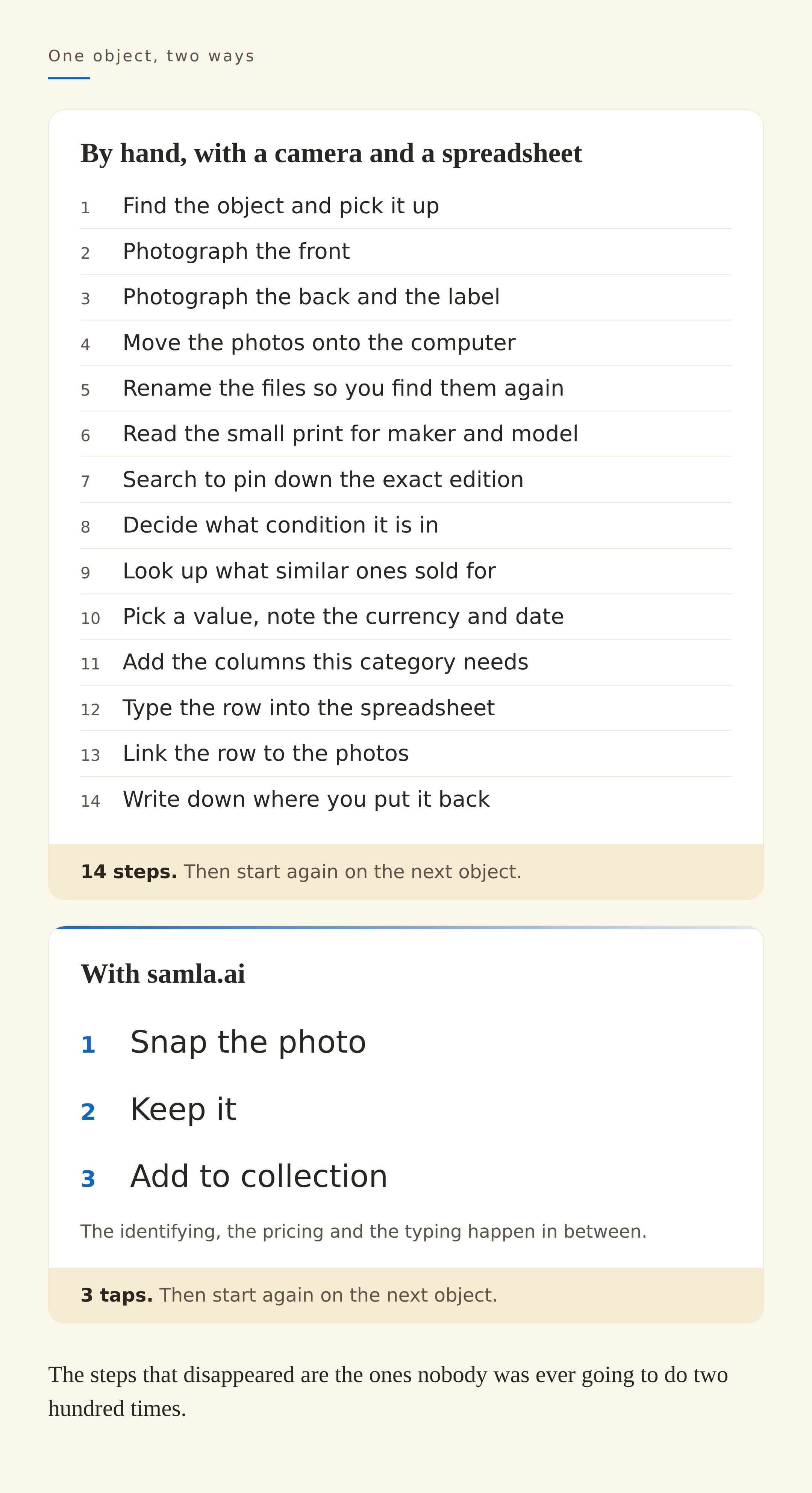
Fourteen steps for one object
The manual version is longer than it looks. Find the object. Photograph the front, back and label. Transfer and rename the files. Read the small print. Search for the correct edition or model. Judge the condition. Find comparable sales. Choose a value and date it. Add the category-specific columns your spreadsheet lacks. Type the row, link the photographs and note where you put the object back.
Then begin again. Each step is reasonable by itself. Together they explain why so many household spreadsheets have eleven rows and have not been opened since March.
Good tools change behavior
People do catalog when the tool fits the job. Discogs users added more than 114.2 million items to their collections in 2025, after adding 105.7 million in 2024. Discogs benefits from one domain, a shared database and decades of community work. A kitchen, wardrobe or garage has no equivalent database, so the research and typing fall back on the owner.
What AI changes
AI changes the cost per item. Point a camera at an object and samla.ai identifies what it can, fills in the relevant fields, and estimates a value from market information. You review the result, choose where the item lives and add it to your collection.
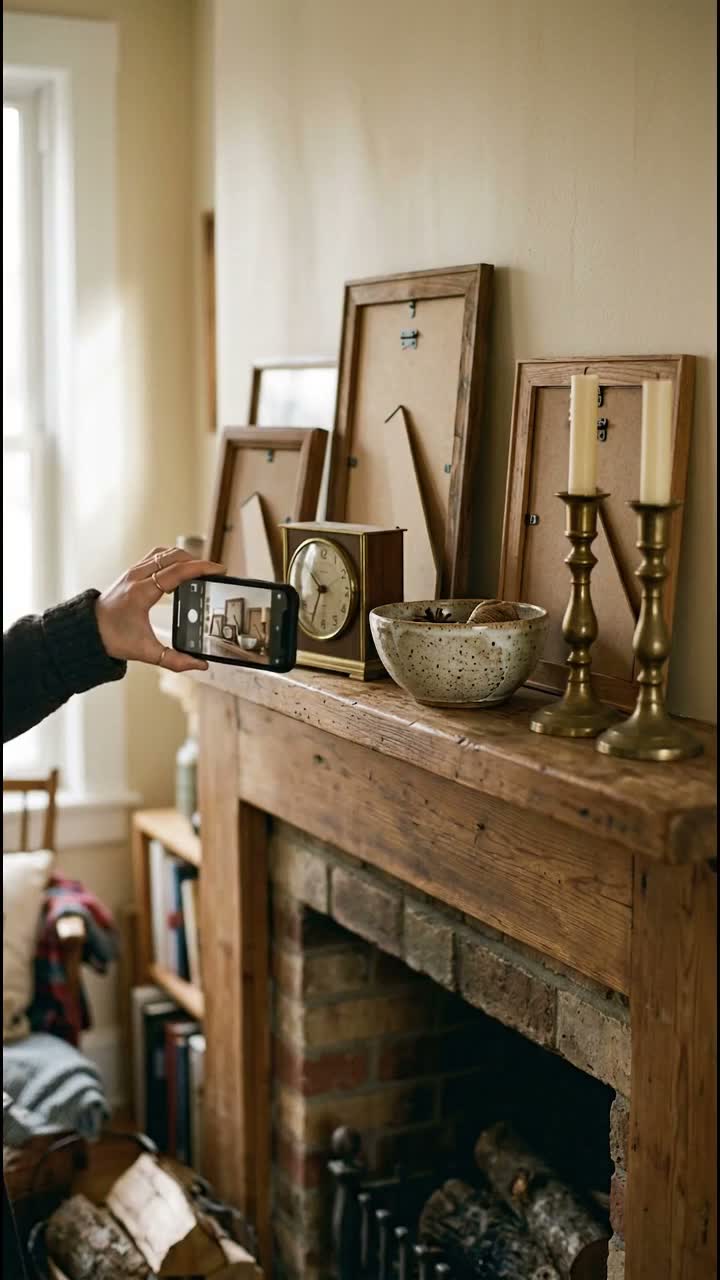
The interface is deliberately ordinary: a camera pointed at a thing. You do not need to write a prompt or understand which model is running. When a result has low confidence or missing details, it goes to Review for a human check. A confident result can still be wrong, so every field remains editable. Values are estimates for information, never professional appraisals.
The important change is not that cataloging became magical. It is that checking a filled-in record is much faster than creating a blank one. The per-item cost stops overwhelming the eventual reward.
What a finished inventory gives you
Once the data exists, it becomes useful in more than one direction.
- A record when you need one - for an insurance claim, a move or a water leak, none of which is a good time to begin from memory
- Better everyday decisions - what you already own, what is worth insuring, what to lend, and what you are ready to sell or give away
- Things kept in use - knowing what is in the cupboard makes it easier to reuse it, share it or pass it to someone who wants it
The secondhand market is already broad. In eBay's 2025 Recommerce Report, 86 percent of eBay sellers said they sourced inventory from their own belongings. OfferUp reported that 93 percent of Americans had bought something secondhand that year. Those numbers do not guarantee a buyer for every object, but they show that reuse is no longer a niche behavior.
The stories attached to things
Eventually, somebody else has to understand what we kept. A life adds objects steadily and lets go of them slowly: tools, china, records, and boxes in the loft that arrived from somebody else's loft. The people with the most to document are often the least likely to begin because the collection took decades to build.
Sweden has a word for dealing with this while there is still time: döstädning. Dö means to die and städning means cleaning. The artist Margareta Magnusson gave the idea an international audience with The Gentle Art of Swedish Death Cleaning. Her daughter Jane told The World that her mother's apartment was "pretty much empty when she died."
The idea is about stories as much as disposal. You explain what each thing is and where it came from while you are still the person who knows. An object with its story attached can be an heirloom. The same object without the story may look like clutter. A catalog gives the photograph, facts and memory somewhere to stay together.
Cataloging does not have to become the older generation's homework. A family can share one collection in samla.ai, and joining a family is free on every plan. The person comfortable with the phone can scan while the person who knows the objects tells the stories. That gives those stories a better chance of surviving the handover.
One shelf is enough
Do not begin with the whole house. Pick the shelf you would least like to reconstruct from memory and add that. One completed shelf shows you what a room could become without turning the first session into a test of endurance.
Continue in whatever order interests you. Somewhere during the first room, the inventory stops feeling like a list you are feeding and starts becoming something you consult. That is when the reward finally catches up with the work.
FAQ
Do I have to catalog everything before it becomes useful?
No. One room can already help with replacement values, duplicates and everyday decisions. Its usefulness grows as the coverage grows.
Is the app professionally appraising my things?
No. The app provides an estimate from available market information, and you keep the final say on every field. A specialist dealer or auction house is the right next step for something genuinely rare.
What happens when the AI is wrong?
Low-confidence or incomplete results are sent to Review, but a confident result can also be wrong. Every field is editable, and checking a filled-in record is faster than starting with a blank one.
Is this only useful for collectors?
No. Collections are where cataloging is often most enjoyable, but a household inventory uses the same camera and record. Kitchen, garage and wardrobe items belong on the same kind of list.
Sources
- Insurance Information Institute: facts and statistics, homeowners and renters insurance (2023 Triple-I/Munich Re survey)
- Discogs: more than 114 million items collected in 2025
- eBay 2025 Recommerce Report
- OfferUp 2025 Recommerce Report
- The World: remembering Margareta Magnusson, who introduced "Swedish death cleaning" (March 2026)